RELIGION
Mesopotamian religion has a long history of development, stretching well beyond the third millennium BC. Its roots lie in the prehistory of Sumerian civilization, before the invention of writing or the formation of city-states. Before being crowded into a dense urban environment with its unique set of protocols and hazards, the early Sumerians lived in diffuse village communities. They encountered nature on a more basic and immediate level. Hence it is no surprise that their theology and religious practices acquired a naturalistic character. The earliest Sumerian pantheon included gods for the sun, moon, sky, and earth, as well as a number of chthonic deities associated with growth and snakes. The deities lacked anthropomorphic features, and did not fit into a clear hierarchy of authority.
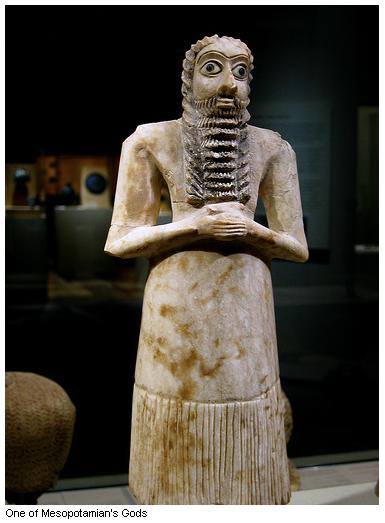
Once the Sumerians developed a culture centered around the city-state, however, the character of their religion changed. The prehistoric gods acquired human characteristics, including gender and propitiatory epithets. The surviving prehistoric gods were:
Utu, the sun god, Nanna, the moon goddess, An, the sky god, Inanna, the sky goddess, Enki, the earth god, Enlil, the 'Ether' god, Ninhursag, the lady of the Hills, Ninazu, the lord of healing, Ningishzida, the lord of the True Tree,
Towards the end of the third millennium, many of these deities were equated with their Semitic counterparts. Thus Utu corresponded to Shamash, Nanna to Sin, and Enki to Ea.